
The Relic-pool reference begins after this fixed ad boundary.
Separate Dude Relics from Family Relics
Every selected Dude Type contributes seven Dude Relics to the run’s pool. Every represented Family contributes eight Family Relics, and each Relic is added only once. These are two separate inputs. A five-Dude team always has five Dude Type selections, but the number of represented Families can range from concentrated to broad depending on the roster. That difference changes the Family portion of the pool.
The rule does not say that a larger pool is automatically stronger. A broader set of Families creates access to more Family Relics, while a concentrated roster avoids introducing as many Family sets. The right comparison is between access and focus for the current run. This page explains the pool shape and the decision sequence without assigning values to individual Relics that are not named in the supplied first-party inventory.
| Pool input | Confirmed contribution | Decision affected |
|---|---|---|
| Dude Type | Seven Dude Relics | What each selected type can add |
| Represented Family | Eight Family Relics | How broad the Family pool becomes |
| Duplicate Family representation | Family Relics added only once | Additional same-Family Dudes do not duplicate the set |
Count represented Families after choosing the five Dudes
The team contains five Dudes, so the pool calculation starts with five selected Dude Types. Then count distinct Families among those five. If several Dudes share one Family, that Family’s eight Relics enter once. If the roster spans additional Families, each newly represented Family contributes its set once. This is the confirmed reason team composition changes the pool before any individual Relic is evaluated.
Use the count as a planning lens rather than a formula for a best build. A roster with more represented Families may expose more Family options, but that can also make the Family portion less concentrated. A roster with fewer represented Families may be more focused, but it gives up access to other Family sets. The available Dude affinities, current mode, and run pressure determine whether breadth or focus is more useful.
Use “Count represented Families after choosing the five Dudes” as a run checkpoint rather than a universal ranking. Before applying “Count represented Families after choosing the five Dudes,” note the current five-Dude roster, the Families already represented, and the immediate pressure shown by the encounter. A short “Count represented Families after choosing the five Dudes” record makes the result easier to compare after battle while keeping unsupported exact values, hidden formulas, and one-size-fits-all builds out of the decision.
Evaluate a three-choice Relic screen in context
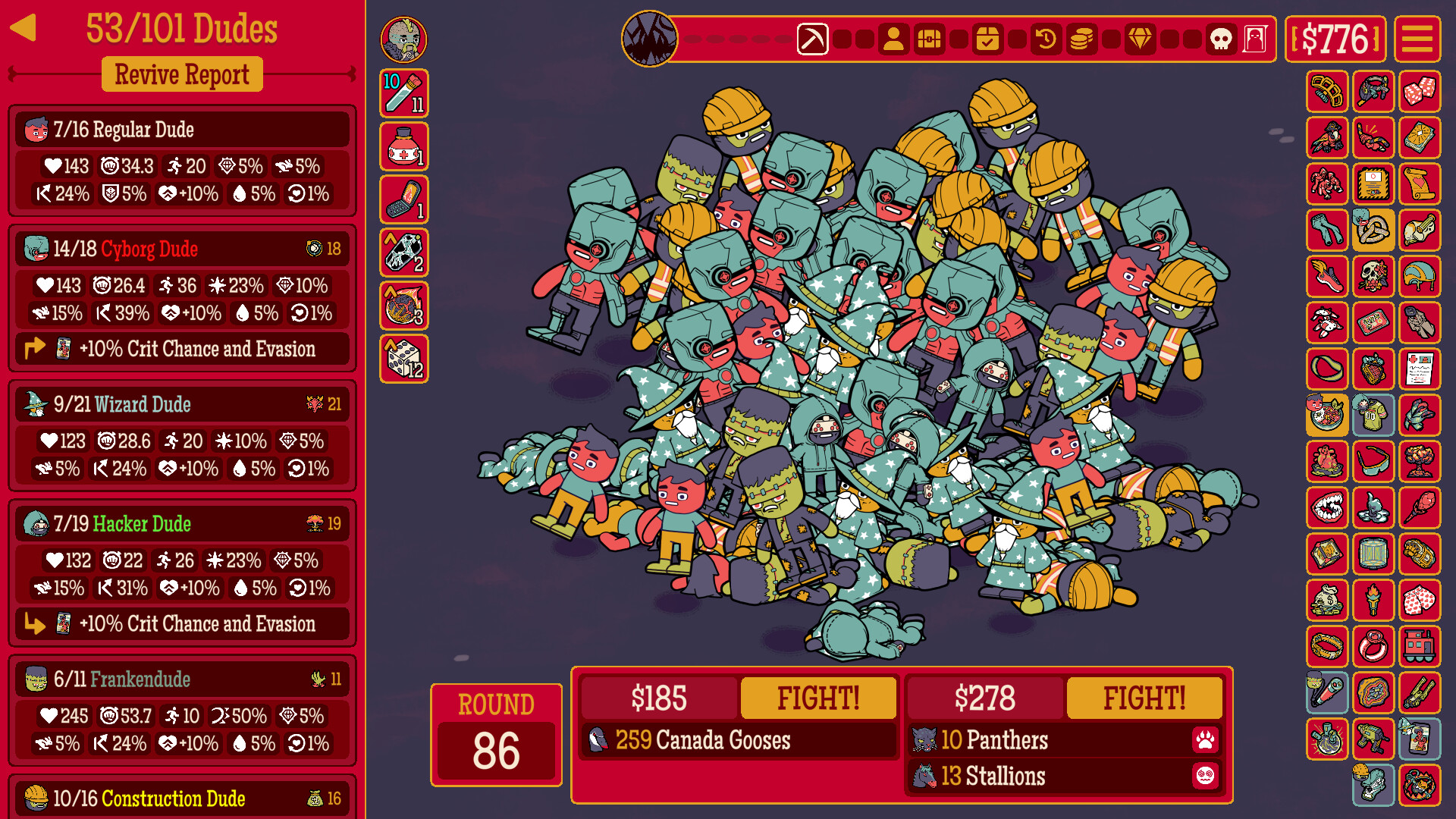
The official screenshot presents Relics as a three-choice decision. Start by identifying whether each option supports a Dude Type already central to the team or a Family represented by the roster. Next, connect the option to the immediate problem: recovery time, investment protection, early defense, pursuit of a moving boss, or another confirmed run need. Finally, compare the cost of taking a narrow improvement against the value of keeping the broader plan coherent.
Do not infer exact drop rates from one screen, and do not treat a screenshot appearance as proof that a Relic is always available. The pool rule determines what can enter; the current choice screen determines what is offered at that moment. This separation keeps roster planning, pool composition, and individual selection from collapsing into one unsupported tier list.
- Identify the Dude Type or represented Family connected to the option.
- Match the effect to the run’s current pressure.
- Choose for the five-Dude plan, not for a generic ranking.
Keep Relics and Trinkets as different decisions
Relics reshape runs and are drawn from the pool created by Dude Types and represented Families. Trinkets are boss rewards assigned to a Dude Type. Both can amplify a strategy, but their acquisition and planning questions differ. A Relic decision asks what the roster has put into the pool and which offered option helps now. A Trinket decision asks which Dude Type receives a boss-earned modifier and how that assignment fits the team.
Keeping the systems separate improves lookup. Use this page before and during Relic choices. Use the Trinkets page after an Act boss reward needs to be understood. Use Team Building when the underlying question is whether adding a new Family is worth broadening the pool. The pages link to one another because the systems interact, not because the terms are interchangeable.
Use “Keep Relics and Trinkets as different decisions” as a run checkpoint rather than a universal ranking. Before applying “Keep Relics and Trinkets as different decisions,” note the current five-Dude roster, the Families already represented, and the immediate pressure shown by the encounter. A short “Keep Relics and Trinkets as different decisions” record makes the result easier to compare after battle while keeping unsupported exact values, hidden formulas, and one-size-fits-all builds out of the decision.
Relic pool questions
How many Relics does one Dude Type add?
FAQ: The official developer guide states that each Dude Type contributes seven Dude Relics to the pool. That is separate from the Family contribution, so selecting a Dude can affect both the type-specific portion and, when its Family is newly represented, the Family portion.
How many Family Relics does a represented Family add?
FAQ: Each represented Family contributes eight Family Relics, with each Relic added only once. Adding another Dude from a Family already represented does not add a duplicate copy of the same Family set, while introducing a new Family adds that Family’s set.
Is a larger Relic pool always better?
FAQ: The confirmed sources define how the pool grows but do not say that maximum breadth is always strongest. More represented Families create more access; fewer represented Families keep the Family contribution narrower. Evaluate that tradeoff against the current five-Dude plan and run pressure.