
The composition guide begins after this fixed ad boundary.
Start with five slots, not a universal tier list
A How Many Dudes? team contains five Dudes. The developer reports more than 850,000 possible five-Dude compositions, which makes the roster a search space rather than a solved five-name answer. A practical build begins by defining the run problem: recovery timing, investment protection, burst defense, pursuit of a moving boss, or another confirmed system pressure. Then assign the five slots to a plan that addresses it.
The supplied evidence does not publish a complete roster stat table or a developer-approved best team. That means this guide should not manufacture exact rankings. It can still provide a reliable structure: select five Dude Types, check their differing stat affinities, count represented Families, account for the Relic-pool contributions, and revisit the plan after a Trinket or mode changes the context.
Use “Start with five slots, not a universal tier list” as a run checkpoint rather than a universal ranking. Before applying “Start with five slots, not a universal tier list,” note the current five-Dude roster, the Families already represented, and the immediate pressure shown by the encounter. A short “Start with five slots, not a universal tier list” record makes the result easier to compare after battle while keeping unsupported exact values, hidden formulas, and one-size-fits-all builds out of the decision.
Use affinities as differences among Dudes, not Family stereotypes
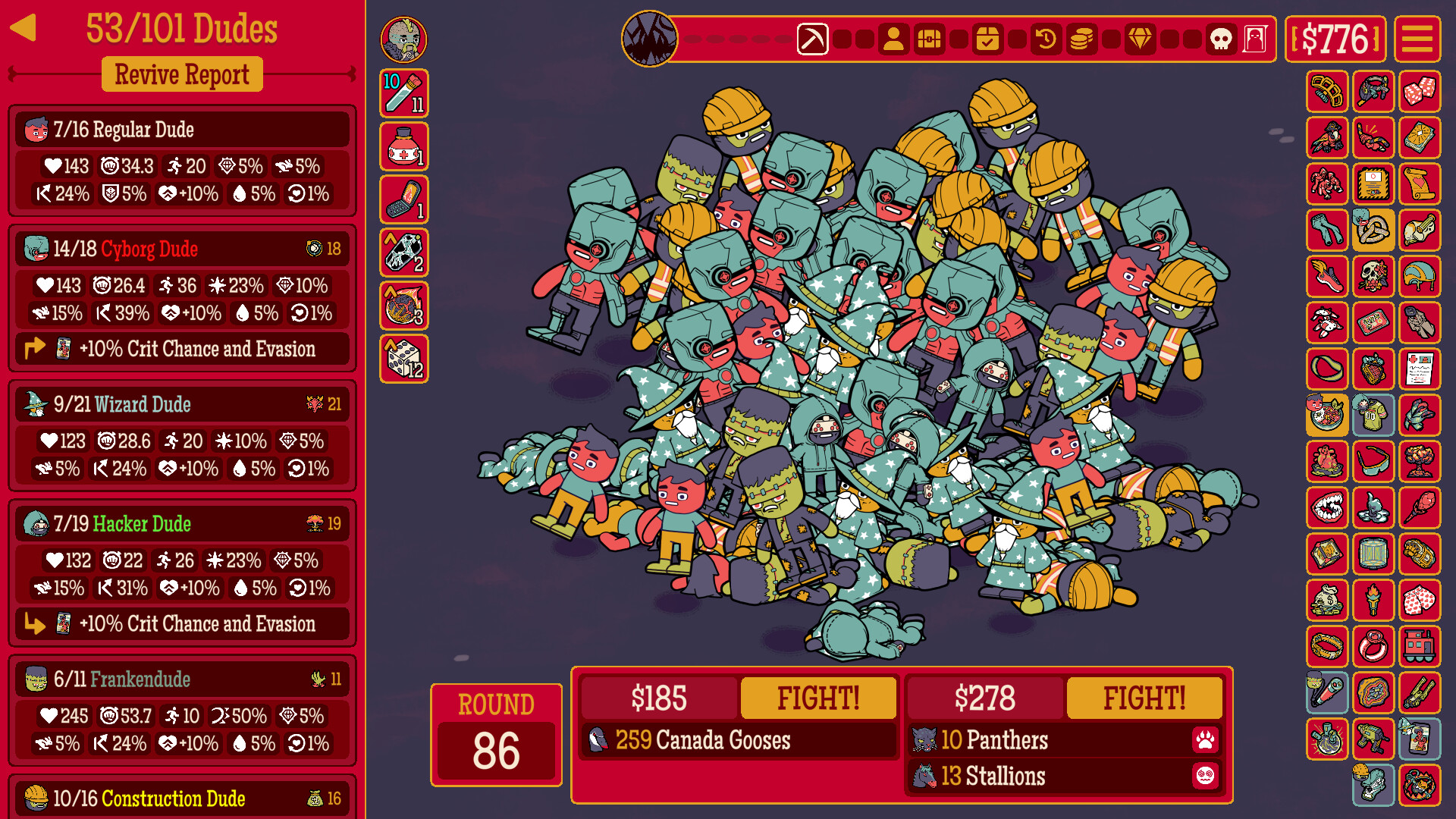
The official guide states that stat affinities differ by Dude. This supports comparing what individual selections naturally emphasize, but it does not support assigning one fixed stat profile to every member of a Family. Build decisions should therefore move from the Dude outward: identify the affinity visible in the game, connect it to the current need, and then evaluate how the Dude’s Family affects the pool.
For boss preparation, the named needs are clear. Toughness, Max HP, and Temporary Health address large hits. Mobility helps pursue moving bosses such as G.O.A.T. Those categories can guide the five-slot plan without inventing exact breakpoints. A team may combine several ways to solve the same problem, and a composition can change when the mode or available recruitment flyers change.
| Run pressure | Confirmed preparation category | Roster question |
|---|---|---|
| Large bursts | Toughness, Max HP, Temporary Health | Which available Dudes support survival? |
| Moving boss | Mobility | Can the team maintain pursuit? |
| Recovery delay | Survive a few rounds | Can five slots preserve the recovery window? |
| Investment timing | Protect the three doubles | Can the team remain stable while cash is committed? |
Count distinct Families after the five Dude Types
Each selected Dude Type contributes seven Dude Relics. Each represented Family contributes eight Family Relics, with each Relic added only once. The composition decision therefore has two layers. Five different Dude Types define the type-specific contribution, while the number of distinct Families defines the Family contribution. Repeating a Family can keep that portion narrower; adding a new Family introduces another Family set.
This is a tradeoff between focus and access, not a rule that diversity or concentration always wins. More represented Families can create more Family options. Fewer represented Families can reduce the breadth of that part of the pool. Compare the tradeoff with the Dudes’ actual affinities and the current run problem. Do not sacrifice a needed defensive or Mobility response merely to maximize or minimize the number of Families.
Use “Count distinct Families after the five Dude Types” as a run checkpoint rather than a universal ranking. Before applying “Count distinct Families after the five Dude Types,” note the current five-Dude roster, the Families already represented, and the immediate pressure shown by the encounter. A short “Count distinct Families after the five Dude Types” record makes the result easier to compare after battle while keeping unsupported exact values, hidden formulas, and one-size-fits-all builds out of the decision.
Use a repeatable five-step team check
First, define the pressure the run must solve. Second, fill the five slots with available Dude Types whose confirmed in-game affinities support that need. Third, count distinct Families and understand what that does to the Family Relic contribution. Fourth, remember that every selected type adds seven Dude Relics. Fifth, reevaluate after a boss Trinket, a new recruitment opportunity, or a mode-specific starting condition changes the plan.
The workflow stays useful because it is based on stable system facts rather than a patch-sensitive ranking. It also explains where to go next. Open Characters to verify Family structure, Relics to examine the pool, Trinkets to interpret a boss reward, Walkthrough for the beginner sequence, and Game Modes when Daily Dude, Ensemble, Rematch, or Pre-Posted Flyers alter the opening context.
- Define the current run pressure.
- Select five Dude Types by the affinities shown in game.
- Count represented Families and pool breadth.
- Review Dude Relic contributions.
- Reassess after rewards or mode changes.
Read the 850,000 figure as possibility, not proof of balance
The publisher’s “more than 850,000” composition figure communicates how many five-Dude combinations the roster can produce. It does not prove that every composition is equally strong, that all modes reward the same plan, or that one public tier list can settle the game. Use the number to understand why the wiki separates roster facts, system rules, and walkthrough checkpoints.
A high combination count also raises the cost of unsupported advice. Publishing one exact best team without a complete verified roster dataset would turn a marketing-scale fact into false precision. The better approach is to expose the decision variables the official sources confirm: five slots, differing affinities, Dude Relics, represented Families, boss-earned Trinkets, Tiers, and mode-specific starting conditions.
Use “Read the 850,000 figure as possibility, not proof of balance” as a run checkpoint rather than a universal ranking. Before applying “Read the 850,000 figure as possibility, not proof of balance,” note the current five-Dude roster, the Families already represented, and the immediate pressure shown by the encounter. A short “Read the 850,000 figure as possibility, not proof of balance” record makes the result easier to compare after battle while keeping unsupported exact values, hidden formulas, and one-size-fits-all builds out of the decision.
Team-building questions
How many Dudes are in a team?
FAQ: Every team contains five Dudes. The full release has 42 unique Dude Types, so the five-slot limit is the main selection constraint behind roster lookup, Relic-pool planning, and the reported breadth of more than 850,000 possible compositions. Use the “how many dudes are in a team” boundary when reviewing the next run, and keep any stronger conclusion separate until an official rule or clean first-party record supports it.
Should a team use as many Families as possible?
FAQ: The official rules do not establish that as a universal goal. Each newly represented Family adds eight Family Relics once, which increases access but broadens the pool. Repeating Families can keep that contribution narrower. Compare the tradeoff with affinities and the current run need.
Does this guide provide one best five-Dude team?
FAQ: No complete first-party roster dataset or developer-approved universal lineup is present in the supplied evidence. The guide provides a repeatable composition process tied to confirmed systems, so players can evaluate available Dudes without an invented tier list. Use the “does this guide provide one best five-dude team” boundary when reviewing the next run, and keep any stronger conclusion separate until an official rule or clean first-party record supports it.